AI can put a workout on my watch. Did I actually run it?
I matched 128 planned sessions from my 2026 Garmin calendar with what I recorded. Seven in ten of my own plans happened on the day, but only 38% of all of them ran as the workout on my watch, and inside those, 65% of the steps with a target landed in it.
- Own training data
- AI-assisted, author-checked
Planned, done, moved, swapped, skipped. (AI-generated illustration)
I wrote about planning a training week with an AI assistant and sending a workout to the watch earlier. That article ended where the watch sync begins. This one is about what happened next, and not for one week but for a whole season.
I run, I race triathlons and trail ultras, and I write software. Garmin MCP is my unofficial, open-source MCP server for Garmin Connect. It can read the calendar back, past months included, and it can show an activity's laps next to the workout steps they belong to. So I asked the question every training plan quietly avoids: how much of what I put on the calendar did I actually do, and how close to the targets?
What I compared
The plan is everything on my Garmin calendar between 1 January and 18 November 2026: 137 scheduled workouts. Most I wrote myself, a few days ahead or on the morning itself. A block of sessions for a middle-distance triathlon in August was written in early July. Twenty were generic sessions ("easy run", "core workout", "FTP builder" with a stock description) that a connected app had put on my calendar.
Nine entries were the same kind of session for the same sport on the same day, usually a workout scheduled twice. I folded those, which left 128 plan items.
The other side is my activity list: 376 activities in the same window, with every triathlon leg counted as its own sport. For each plan item I looked, in this order, for:
- Done, as the workout: an activity that ran this very workout on the watch. Garmin stores the workout id with the activity.
- Done, without the workout: an activity of the same sport on the same day.
- Moved: the workout run on another day within three days, or the same sport the day before or after, on a day with nothing of that sport planned and of a plausible length.
- Another sport instead: no match, but a different training activity that day (walks do not count).
- Skipped: nothing.
Everything came from the server's local cache, plus 150 requests to Garmin. 82 of them fetched the laps and workout steps of the sessions I ran as workouts; the rest went to six calendar months I had never opened and the server's routine refresh of reference data.
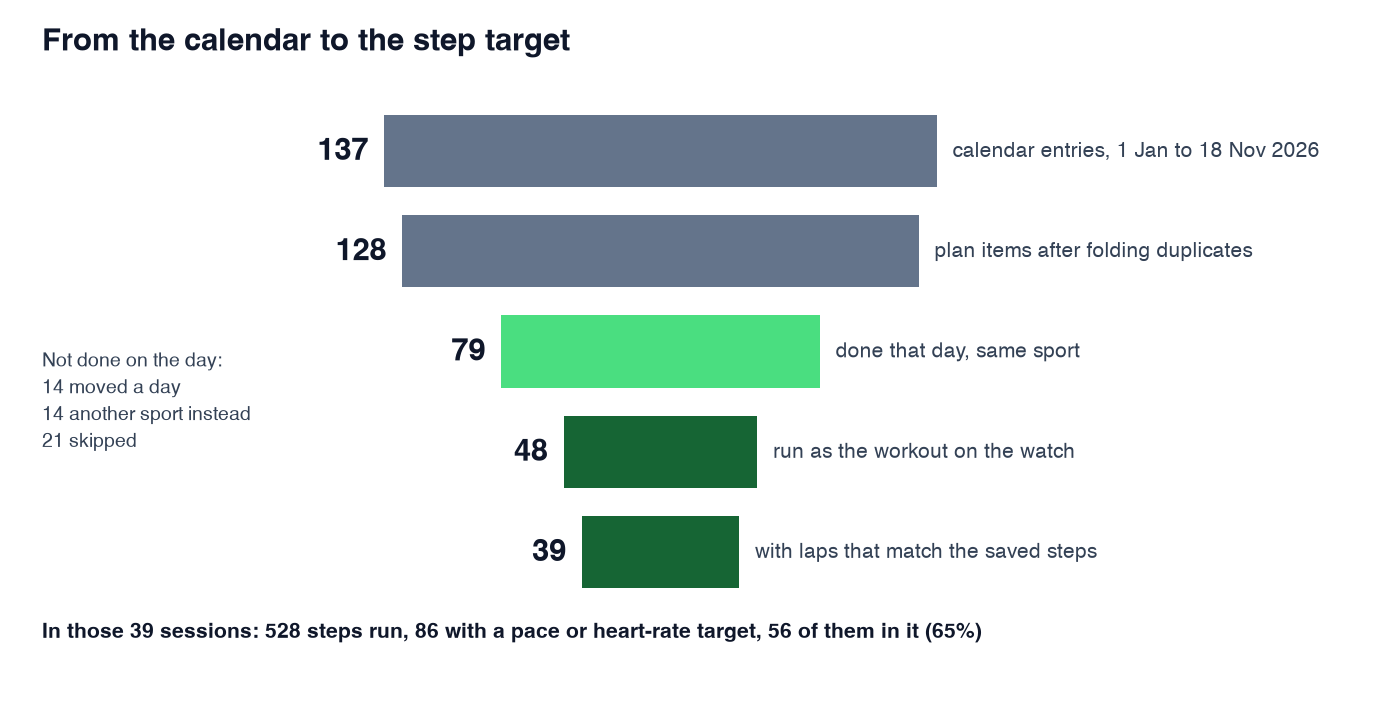
How far each plan got. The last line counts workout steps, not sessions.
On the day: 62% done, 38% on the watch
Of the 128 plan items, 79 were done on the planned day in the planned sport, 62%. Another 14 were moved by a day, 14 turned into a different sport, and 21 did not happen.
The generic app sessions pull that number down a lot. I did 3 of those 20 on the day. Of the 108 sessions I wrote myself, I did 76, or 70%.
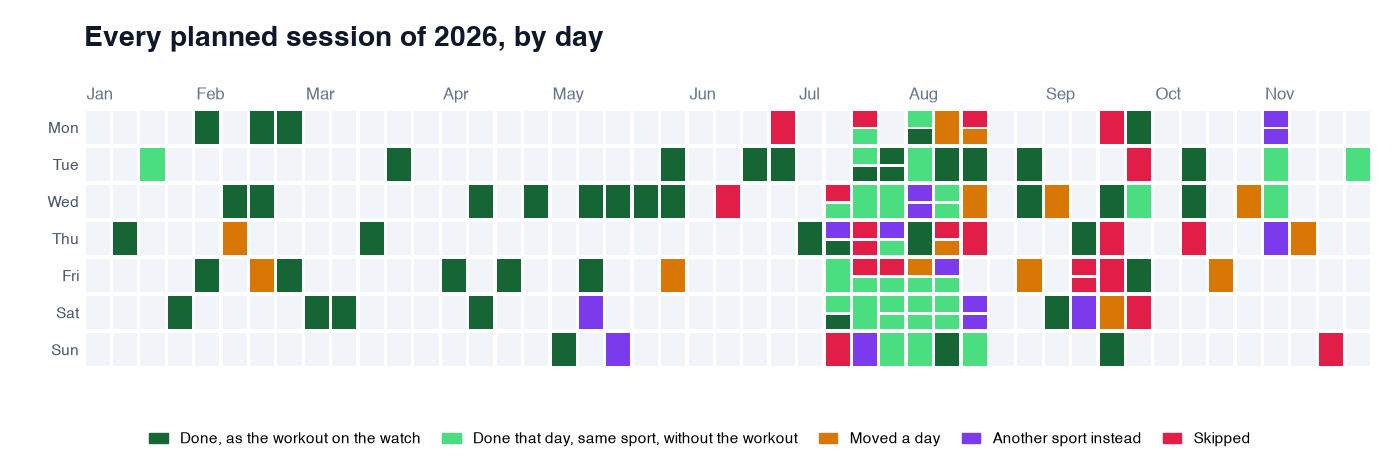
Each cell is one day; a day with two planned sessions is split in two.
The calendar shows three different seasons. From January to June I planned one key run at a time, usually on the morning itself (20 of 34) or by picking an old workout from the library, and did 28 of the 34. In July and August, the triathlon block, I planned up to two sessions a day, many of them three to six weeks ahead, and did 39 of 63. From September on, my own plans went back to 9 of 11, and the generic app sessions made most of the red.
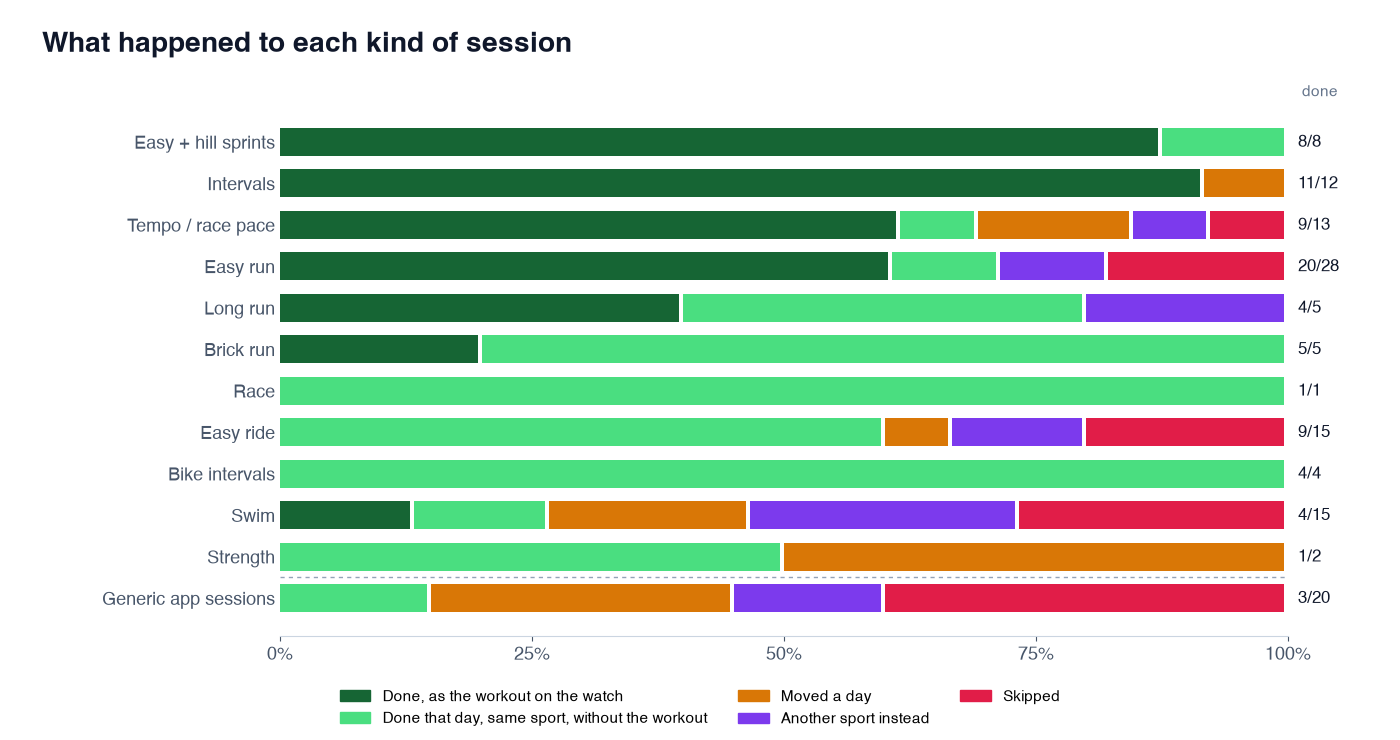
Share of each kind of session by outcome. The generic app sessions are counted on their own row.
What gets dropped is not what I expected. The hard sessions survived best: all 8 easy runs with hill sprints, 11 of 12 interval sessions, all 4 bike interval sessions. The easy sessions were the ones that moved or vanished: 20 of 28 easy runs and 9 of 15 easy rides.
Swimming was the outlier. I did 4 of the 15 swims I planned on the day. Three more moved by a day, each time to an open-water swim; four became another sport, and four never happened.
Two smaller patterns in my own plans. Every one of the 14 sessions I planned for a Tuesday happened; only 7 of 17 Thursdays did. And workouts I wrote on the day were done 79% of the time (22 of 28), against 58% for those written eight or more days ahead (18 of 31). Old library workouts I picked again were done 13 times out of 15. A plan made close to the day already knows how the day looks.
Done, but not as the workout
Of the 79 sessions done on the day, 31 were not run as the workout on the watch. All 15 completed bike sessions are in that group: they were indoor rides, recorded as indoor cycling or virtual rides, and none carries the link to its workout. Of the 13 runs done without the workout, 4 were brick runs straight off the bike, 2 long runs and one the triathlon itself.
For a check like this that matters, because only a linked activity knows which lap belongs to which step. The step comparison below covers 39 sessions, all runs; I did not compare the two linked swims. Seven more linked runs were left out on purpose: in six I had edited the workout after the run, so the saved steps are not the ones I followed, and one was split over two recordings.
Inside the workout: 82% of my steps had no target
Garmin writes the index of the workout step into every lap. Consecutive laps with the same index are one executed step, so a 5 km warm-up with automatic 1 km laps counts once. In the 39 sessions I ran 528 steps.
433 of them, 82%, had no target at all. That surprised me more than any compliance number. My warm-ups, hill sprints, strides and recoveries were all "run 100 m" or "until lap button", and many of my workout names carried the pace ("8 km @ 4:35") while the step itself did not. The watch cannot tell me I am too fast if I never told it what fast means.
That leaves 86 steps with a pace or heart-rate range. I count a step in target when its average pace or heart rate falls inside the range, with no tolerance.
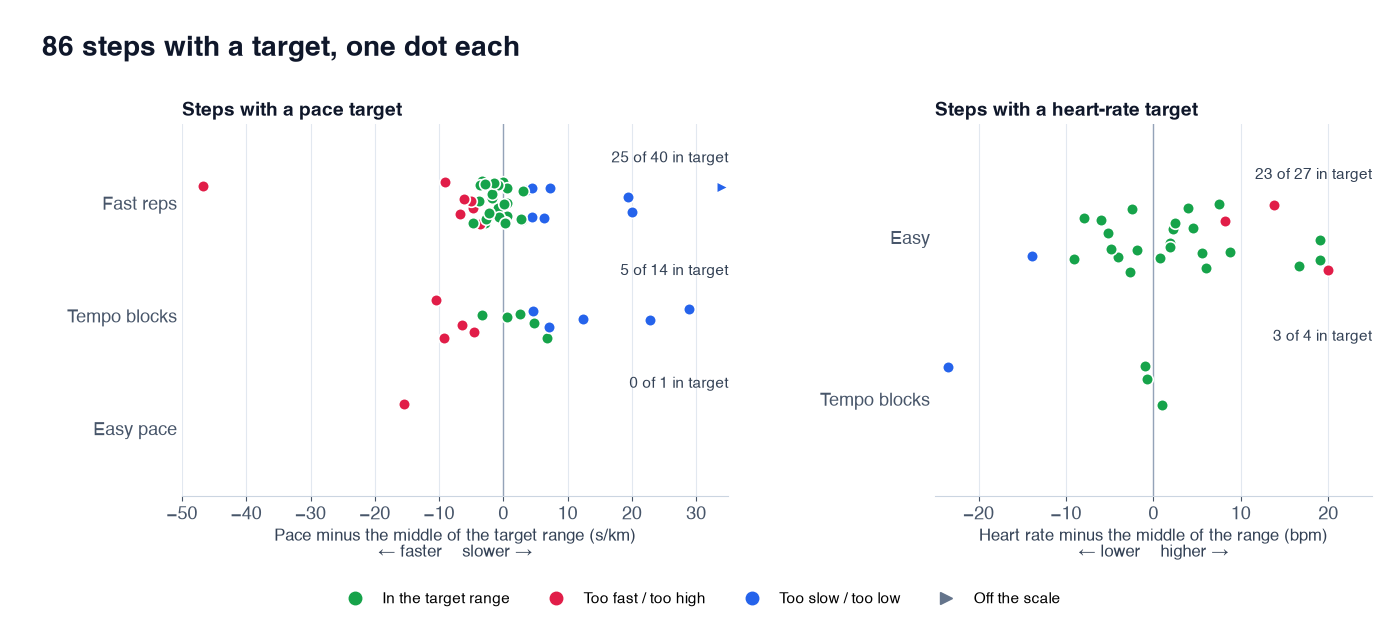
Each dot is one step, coloured by whether it landed in its range. Dots at the edge are off the scale.
56 of the 86 were in target, 65%. By type:
- Easy steps with a heart-rate cap or zone: 23 of 27 in. When I gave myself a ceiling, I mostly stayed under it. The three that went over, a cool-down, a recovery and an easy block of a long run, did so by 1 to 3 bpm.
- Fast reps with a pace range (400 m to 1 km): 25 of 40 in, 7 too fast and 8 too slow.
- Tempo blocks with a pace range (1.5 to 14 km): 5 of 14 in, 4 too fast, 5 too slow.
The misses were small. The median pace miss was 4 seconds per kilometre outside the range, and 16 of 25 were within 5 seconds. Ranges of 5 to 15 seconds per kilometre are narrow, and an average over a whole kilometre is a strict test. A looser rule would make my number look better without changing the running.
Garmin scores every lap of a workout too, and my server passes that score on as compliance_pct. For the steps I count as in target its median was 70 out of 100, so its rule is stricter than mine, and Garmin does not publish how it is computed. I used my own rule so that each verdict can be checked.
Where the reps go: the second half
The clearest pattern was inside the interval sessions. In the first half of the planned repetitions, 17 of 27 were in target. In the second half, 11 of 33. The difference was not a slow fade into the blue zone only: in the second half I also pressed the lap button 7 times within the first fifth of a rep to skip it, and 2 more reps were never started.
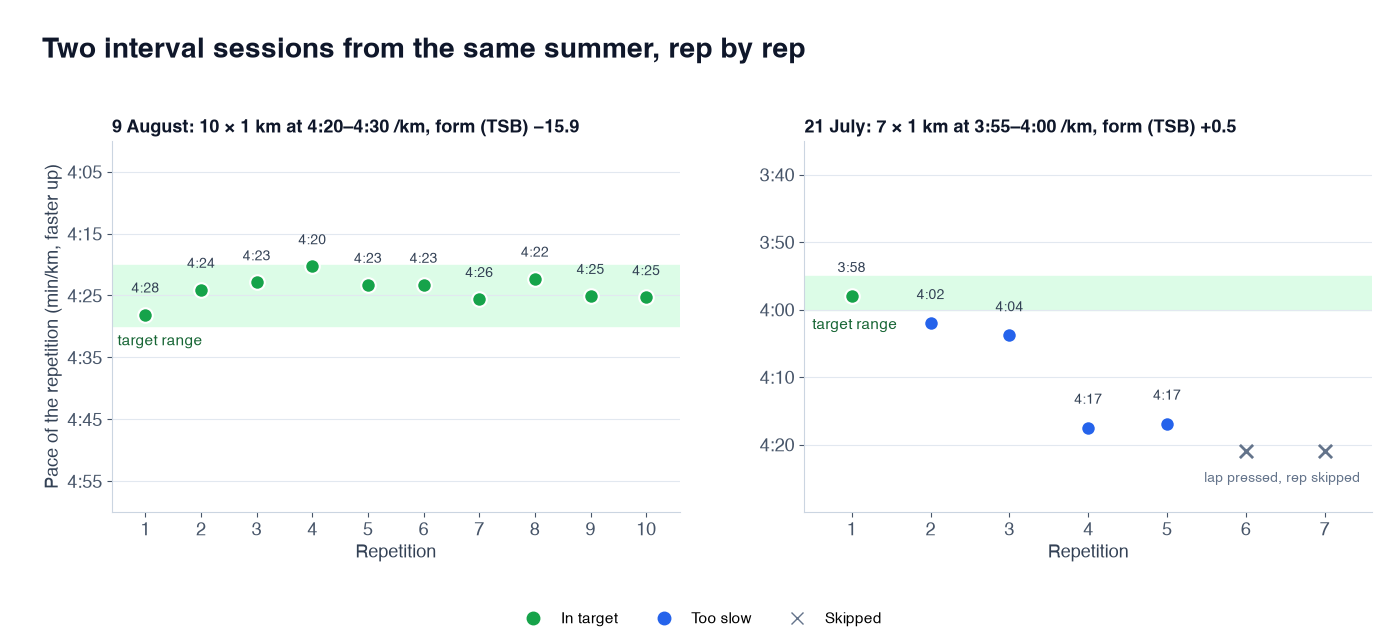
A good day and a fading day from the same summer, rep by rep.
These two sessions are less than three weeks apart. On 9 August, a week before the triathlon, I ran ten 1 km reps between 4:20 and 4:28, every one in its range. On 21 July the range was 3:55 to 4:00. The first rep was 3:58, then 4:02, 4:04, two at 4:17, and I skipped the last two.
Across the 39 sessions, 9 had at least one targeted step skipped with the lap button or not run, and I covered 87% of the planned metres of distance-based steps. That is the part of the plan a weekly total never shows: the session happened, but the last third of the work did not.
Fatigue explained little
The obvious suspect is fatigue. My server's load model gives form (TSB) for every morning: fitness minus fatigue. I wrote about CTL, ATL and TSB on my own season earlier. These are training numbers, not medical advice, and here they explained very little.
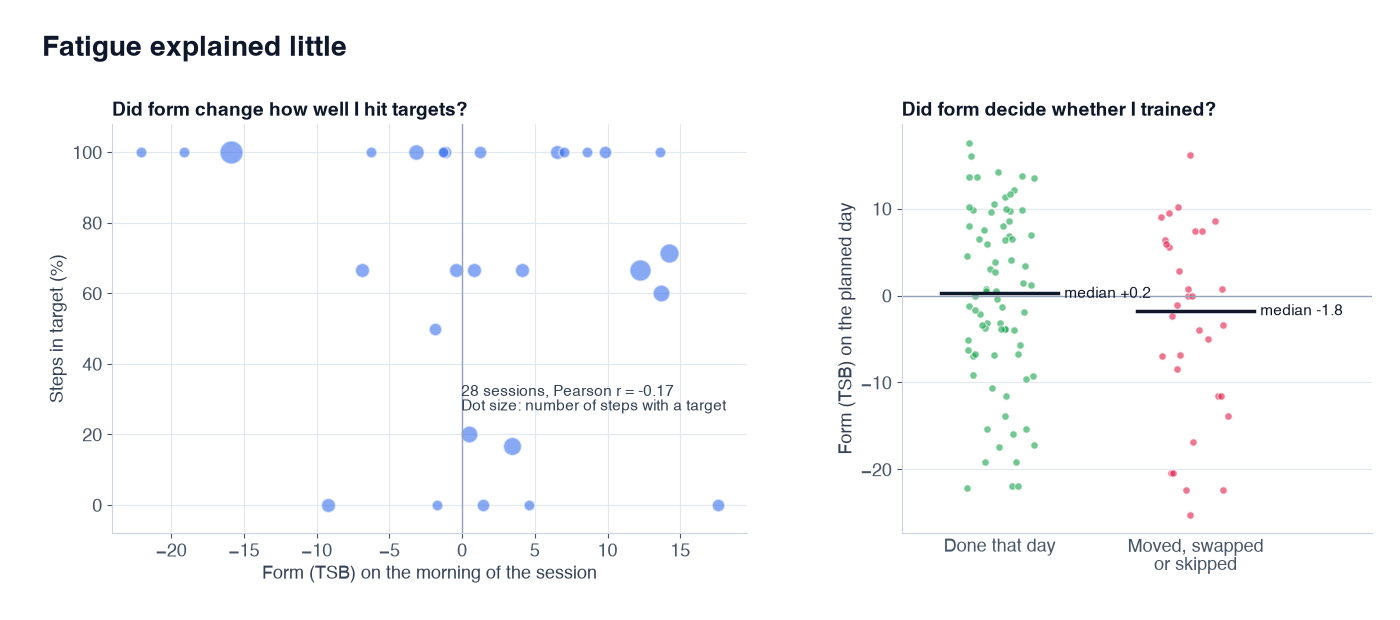
Left: one dot per session with at least one targeted step. Right: my own plan items only.
Across the 28 sessions with a targeted step, the share of steps in target had a correlation of −0.17 with form. If anything I hit more targets when tired (79% of steps when form was below zero, 57% at zero or above), and that is mostly one session, the ten good reps of 9 August at −15.9. Whether I trained at all did not depend on form either: the median was +0.2 on days I did the session and −1.8 on days I did not.
Whatever moved or cancelled my sessions, it was mostly not in the load model. The data cannot say what it was; it only says that a plan written weeks ahead, a swim and a Thursday were the riskiest things on my calendar.
What I take from it
- Targets go into the steps, not the names. A workout called "8 km @ 4:35" with no pace target gives the watch nothing to warn me about. If I care about a number, it goes into the step.
- Fewer, closer plans. Workouts written on the day or picked from the library were done 79% and 87% of the time. The summer block, written weeks ahead with up to two sessions a day, 62%.
- Plan swims as options. At 4 of 15, my swim plan was a wish list. A swim belongs on the week, not on a day.
- Plan the last reps honestly. Most of my misses were at the end of the session. Eight good reps planned are better than ten with two skipped.
- Do not count generic sessions as a plan. 3 of 20 happened on the day. In my data they behaved like suggestions, not like a plan.
None of this needs a spreadsheet anymore. "Compare yesterday's run with the workout I planned" sends the assistant to get_activity with laps, and every lap comes back with the step it belongs to, that step's target and Garmin's compliance score. If the workout was edited after the run, the answer says so, the same trap that made me leave out six sessions here. list_workouts reads the calendar for any range up to three years back or ahead, and get_load gives the form for each day.
Limits
- One athlete, one season, my rules. 128 plan items and 86 targeted steps from me. The rules for "moved" and "another sport" are my choices, and a run the day after a planned run could be either a moved session or just a run.
- The link is the watch's. Only activities started as the workout carry its id. Indoor rides, and runs where I did not start the workout, are matched by day and sport only and have no step comparison.
- Averages per step. A 1 km rep that starts too fast and ends too slow can average out inside the range. I compared plain pace, not grade-adjusted pace, because that is what the watch shows against the target.
- Heart-rate zones are today's. Steps set to "zone 2" were checked against my current zones; my older zones are not stored.
- No planned load. Garmin workouts carry no planned training stress, so I could compare steps, distance and days, but not planned against actual TSS.
The code and documentation:
- Repository: https://github.com/endurancetools/garmin-mcp
- Documentation: https://endurancetools.github.io/garmin-mcp/
Unofficial; not affiliated with or endorsed by Garmin.
Some illustrations in this article were generated with ChatGPT.
 Follow @marcin_running on Instagram